
IntelliFarm
Improving crop performance through innovation and information delivery

2nd place
2021 Women in AI Hackathon
IntellliFarm is the next generation in AI and Machine Learning informed farming,
IntelliFarm was the result of a three-day hackathon with Women in AI. The goal of the hackathon was to provide high technological solutions through AI and Machine Learning to provide an impact on one of the UN's sustainable goals. Our assignment was food-insecure communities.
Because of the uniqueness and time constraints of the challenge, certain methodologies such as user interviews and usability testing could not be employed. Instead, this project focuses on secondary research informing personas and user journeys. I was also responsible for the design work, from the app to the marketing materials.
Problem
-
2 Billion People without access to safe, nutritious food (SDG: 2+3).
-
450 Million small farmers without data.
-
16,500 food distributors without crop insights.
Solution
IntelliFarm delivers free crops to food insecure communities by using AI-powered sensors to ensure food chain transparency benefiting farms by enabling more productive farmers and benefiting merchants by reducing food fraud.
Tools
-
Figma
-
Google Slides
-
Slack
-
Zoom
Team
-
1 Business Analyst
-
1 Product Designer
-
1 Digital Marketer
-
1 UX Research/Design
Timeline
-
Overall: 3 days
-
Discovery & Research: 1 day
-
Design: 1 day
-
Presenting: 1 day
The Process
Proposal
On day 1 of the hackathon, each team was presented with their team members and their assigned UN Sustainable goal. We were presented with the UN Goal for creating sustainable communities through the elimination of food insecurity.
Specifically, the goal is to "end hunger, achieve food security, improve nutrition, and promote sustainable agriculture."
Key changes to meet this goal include (1) supporting local farmers and markets, (2) making sustainable food choices, including supporting good nutrition for all and fighting food waste, and (3) improving farm technology so we can "feed the world".
Constraints included the incorporation of AI and Machine Learning within our project.
With these in mind, my team spearheaded IntelliFarm: next-generation AI- Informed farming.
Research
Meet Michael the Farmer and Amanda the Purchaser
Due to the constraints we were under, we had no time to do user interviews. Instead, using secondary/desk research, we uncovered two personas. The farmer is our primary persona. For this case, we chose the American farmer. Ideally, the technology would be made available worldwide to support local farming practices and improve sustainability. However, for piloting and testing, we would begin with American farmers.


Our secondary persona is our food purchasers. The primary benefit of our technology would be to farmers, but the secondary benefit and the primary profit source would be the food market, seeking to secure their orders from spoilage before arrival at stores. It would also guarantee for those purchasing organic as it would be able to track any chemicals applied to the crops.
User Journey
One last thing I completed for discovery research was a user journey map. It served to verify IntelliFarm's purpose- to monitor the food from the time it is planted in the ground to when it shows up on the supermarket shelves. it also shows how a portion of the crop is donated to food-insecure communities to satisfy the U.N. sustainable goal.

Tech and Design

The Journey from Seed to Market
With IntelliFarm's technology, crops can be tracked from seed to market. AI sensors in the field can monitor as many variables as needed- from soil moisture content and nitrogen levels. This data is then scrubbed and sent to farmers via a tablet dashboard informing farmers when crops need irrigation, pest control, and fertilization. Machine learning would also analyze this data to increase crop stability and production.
The next stage would include transportation monitoring, ensuring trucks are at optimal levels for moving crops to their next destination- whether to markets or food manufacturing plants. Variables such as temperature and moisture levels are considered to avoid spoilage and ensure food arrives in optimal condition.
Wireframes
IntelliFarm relies on sensors as its backbone, but data alone isn’t useful without a way to communicate it to our primary customers—the farmers. We achieve this through a tablet dashboard.
The side navigation allows monitoring of multiple fields. Each field card provides basic information about that specific area. Clicking on a field card replaces the dashboard data with details from that particular field.
Although wireframes were initially completed and presented to the team for feedback, usability tests couldn’t be conducted due to time constraints.

A company is only as successful as its marketing strategy. For this part, our digital marketing specialist worked on developing our strategy, while I worked on developing the one-pager.
Marketing
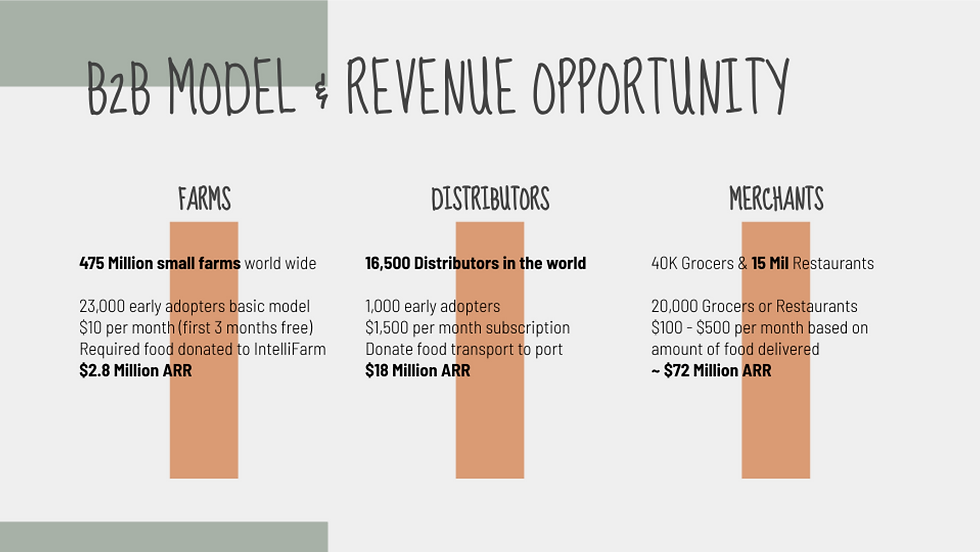

B2B Model & Revenue Opportunity
With 475 million small farms worldwide, 16,500 distributors, and 40K grocers in the United States alone, ample opportunity exists for profit by implementing a subscription model.
Farmers
(1) Increase Yield
(2) Real-Time Control Insights
(3) Fair Competition
Strategy:
Free access to IoT sensors
Monthly subscription for insights
Food donation is set aside for IntelliFarm
Distributors & Merchants
(1) Avoid Food Fraud/ False Labeling
(2) Transparency in Supply Chain
(3) Avoid Food Contamination
Strategy:
Monthly subscription to data and insight portal
Donate transit of food donations to communities in need or ports for IntelliFarm pickup
Next Steps
The next steps would include integrating sensors on food transport trucks, monitoring the temperature and moisture content, and ensuring the freshest food is delivered to markets and manufacturing plants.
The majority of this project was focused on the process- from the sensors in the field, to how new technology would be utilized to provide read-time feedback to farmers and merchants.
What amazed me about this project was how a team positioned in different parts of the world could unite in just three days to meet a deadline with defined constraints. It honestly made me excited that such a product could really exist in the real world and that technology could be used to improve the lives of people who need it the most.
Thank You!
IntelliFarm took second place in the WAI 2001 Hackathon for our innovative technology.
Thank you for reading my case study! Want to work with me? Feel free to contact me! ... or just say hello on my social media.