Agile: Scrum….A Framework for Designers
- Tammie Meloy
- Apr 9, 2021
- 5 min read

After my first few design projects with Flatiron, we were introduced to the idea of sprints. A little reading was provided and the agile methodology was mentioned. But what, exactly, was the Agile Methodology? I decided to do a deeper dive into the idea of Agile and what it means for designers.
My background is as a teacher, so Agile Methodology was a new concept to me. However, I learned that I actually used some concepts from Agile Methodology in my teaching practice.
This week as I did my deep dive, I chose to study the LinkedIn educational course for obtaining your Scrum Master certificate. So, a really deep dive. In this week's blog post, I’ll highlight some of the basics of Scrum, which is one of the Agile Methodology frameworks.

What is Scrum?
Scrum is a lightweight framework utilized to help teams be more effective with less wasted time. Previous to Scrum, and Agile Methodologies, teams worked in a waterfall effect. A lot of time was wasted waiting for the person before you in the chain to finish his tasks before you could start your own. Scrum eliminated much of that wait time.
In Scrum, your team works in sprints to accomplish a determined amount of backlog tasks in order to complete an increment.
Let’s start with the backlog. The team will choose just enough tasks that they think they will be able to finish in a 2-4 week time span. For instance, if they are just starting out with a project, the team may plan to complete during the first phase:
Completing a competitor analysis
Interviewing users
Creating a persona
Each member of the team works together to complete these tasks. Each member of the team is a generalist, meaning if a member of the team is out that day, other members can pick up the load.
Then, when that sprint is done, they review what has been done and the cycle begins anew with the next sprint.
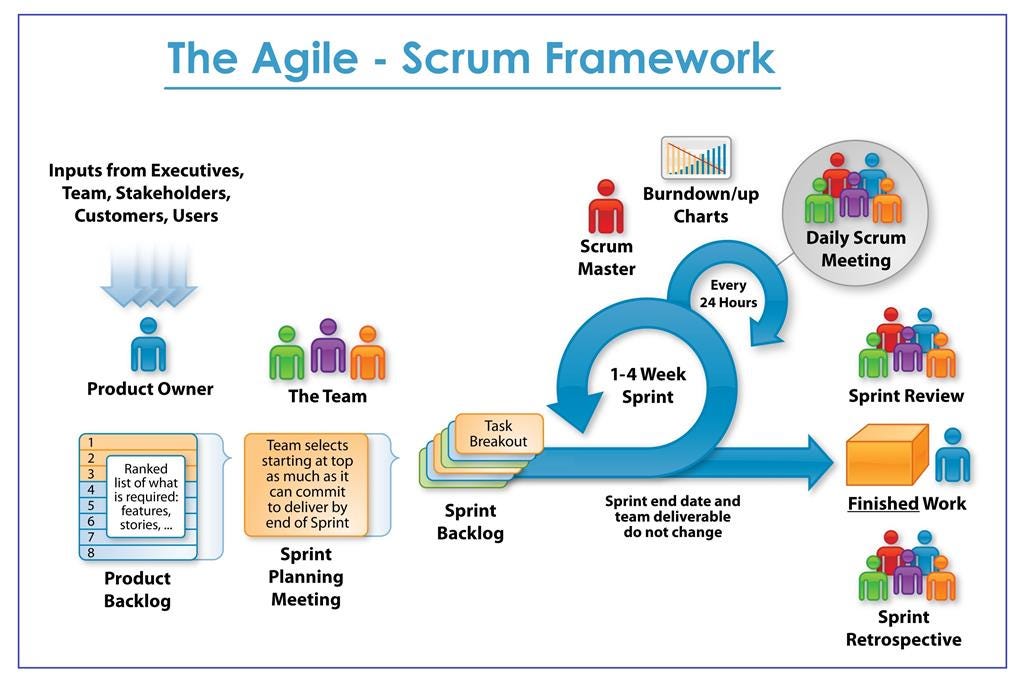
Who is part of the Scrum Team?
A Scrum team consists of the development team, or those working on the project. The team may be composed of between 3 and 9 people and is tasked with shipping a product increment at the end of the sprint. They need to be self-organizing and cross-functional, that is, no one has a defined role and they are all expected to generalize. The entire team holds accountability for the tasks even if it was an individual who signed up for a task.
It also consists of a Product Owner. This is a client or stakeholder representative. The Product Owner is the sole accountable party for the product. They make all decisions regarding product vision and features and the team takes their direction from the PO. Their goal is the maximize the value of the development team by working on the right thing at the right time. They also manage the backlog. Occasionally a proxy may need to step in to support the PO but the PO is ultimately responsible for all the decisions.
A Scrum Master is also part of the team, and their responsibility is to “own the scrum”. They have no control over who does what, their responsibility is to manage the scrum meeting; clearing any obstacles and protecting the team from outside distractions; addressing team dynamics, and ensuring a good relationship between the team and product owner. In this way, the team can focus on work.
What are the Scrum meetings or events?
At the initial start of the phase is the planning meeting, where it is determined how much can be completed during the phase. The selected tasks are pulled from the backlog and entered into a phase backlog, which helps the team keep focused on what it is that should be completed during that phase. Three questions are asked during the sprint planning meeting: Why is this Sprint valuable? What can be done this Sprint? How will the chosen work get done?
Then each day during the phase a scrum meeting, or standup is held. It is to be held standing up and no more than 15 minutes long. The idea of this is to keep everybody on track and to avoid tangents. Everyone is answering three questions: What did they complete yesterday towards the final goal; What do they plan to complete today; What roadblocks do they anticipate may get in their way.
The goal is to have at least a completed increment towards the overall final project at the end of the 2-4 week phase. During the Sprint Review, the team presents the results of their work to the stakeholders, and progress toward the final goal is discussed. Then they can decide what can be done next. The product backlog can then be adjusted accordingly.
At that point, the team meets to reflect on the work that they were able to complete, evaluate what went well, what problems were encountered along the way, and how they were solved (or not solved, as the case may be). The Sprint Retrospective is the conclusion for the Sprint.
Conclusion
This is an extremely short overview of the Scrum framework and processes. What intrigued me the most is that I actually used something similar to this during my teaching career. I plan the lessons that I am going to be teaching during the upcoming month and determine what I can and cannot get done during that time, and at the end, I reflected on what went well and what could be improved upon. When I had common planning time with the academy I was a part of, I was able to attend the academy meetings in which were like stand-ups. In fact, I remember during the academy professional development sessions we had, the trainers encouraged us to do actual stand-ups. My team chose not to do this, and we had tangent discussions every week that I was a part of it. In retrospect, that helped me understand why a team would hold its daily scrum meeting standing up and within a 15-minute timeline.
If I were to go back and reteach the fourth phase of my Bootcamp, it would be to help the students understand exactly why we held sprints, determine a “Scrum master” to hold us accountable, define the roles of our Product Owner were, and so forth. It is nice to finally have a framework in mind for the activity we accomplished.
Scrum is only one framework of the Agile Methodology. There are others, such as Kanban, XP, and Lean. Scrum just happens to be perhaps the most widely known and used.


Comments